
Language
BESS Insulation Monitoring: How Acrel AIM-D100-TS Enhances DC Safety in European Energy Storage Systems
Sep 10, 2026
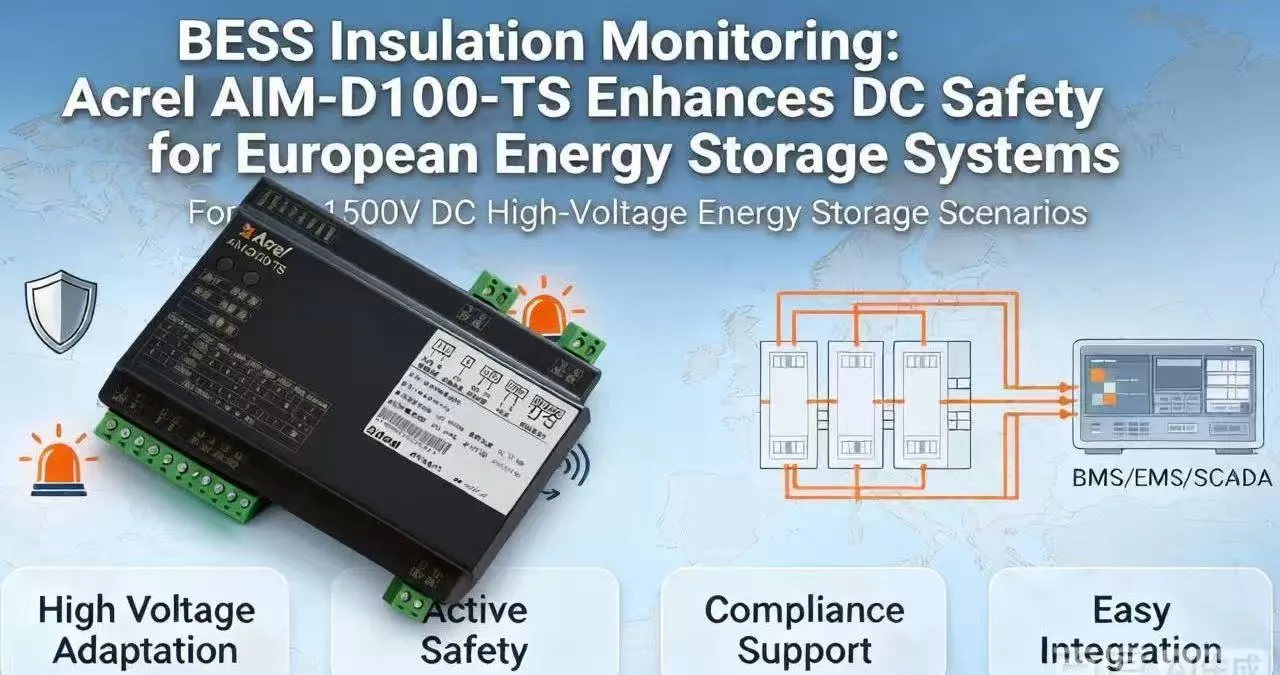
As the share of renewable energy in Europe's energy mix continues to grow, Battery Energy Storage Systems (BESS) are becoming an increasingly important part of the European power system. From large-scale utility energy storage projects to commercial and industrial energy storage, PV-plus-storage systems, and renewable energy integration, BESS is evolving toward higher voltage, larger capacity, and higher power density.
At the same time, the electrical safety of energy storage systems is facing new challenges.
Many high-voltage BESS installations use an unearthed IT system architecture. When insulation performance in a DC system deteriorates, a single insulation fault may not immediately generate a significant fault current. However, if the fault is not detected in time, a second insulation fault may create a hazardous current path, potentially resulting in equipment damage, system shutdown, or even an increased risk of electrical fire.
Therefore, the Insulation Monitoring Device (IMD) has become an important component of the electrical safety architecture of high-voltage BESS.
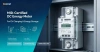
To address this requirement, the Acrel AIM-D100-TS Energy Storage DC Insulation Monitoring Device is designed for 150–1500 V DC energy storage systems. It continuously monitors the insulation resistance between the positive and negative poles of the battery system and earth, providing an active insulation fault warning solution for European BESS projects.
一、 Why Does BESS Need Insulation Monitoring?
In conventional grounded systems, insulation faults can often be detected by protective devices through the resulting fault current.
However, for high-voltage DC BESS using an IT system architecture, the system is not directly connected to earth. When the first insulation fault occurs, the system may still be able to continue operating.
This improves system availability, but it also means that:
The first insulation fault may not immediately cause the system to shut down.
If the fault is not detected in time, further deterioration of the insulation performance of cables, connectors, battery modules, or other components may result in a second insulation fault, creating a more serious electrical hazard.
Therefore, BESS requires a device capable of continuously monitoring:
DC+ → PE (Positive Pole to Earth)
DC− → PE (Negative Pole to Earth)
An insulation monitoring device continuously measures the insulation resistance of the DC system to earth and generates a warning or alarm when the insulation resistance falls below a predefined threshold.
This approach helps BESS move from traditional “fault response” toward “early detection of insulation deterioration.”
二、 Acrel AIM-D100-TS: An Insulation Monitoring Solution for High-Voltage Energy Storage Systems
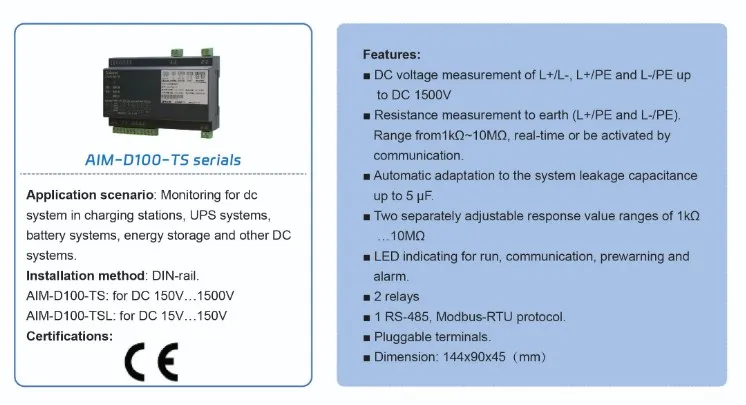
The Acrel AIM-D100-TS is an insulation monitoring device designed for high-voltage DC energy storage systems and is suitable for 150–1500 V DC applications.
The device continuously monitors the insulation status of the positive and negative DC poles to earth, while also measuring system voltage and the voltage of the positive and negative poles relative to earth.
Key Technical Specifications
- System voltage: 150–1500 V DC
- Insulation resistance measurement range: 1 kΩ–10 MΩ
- Pre-alarm/alarm setting range: 10 kΩ–10 MΩ
- Measurement cycle: 500 ms or 1000 ms, selectable
- Communication interface: RS485
- Communication protocol: Modbus-RTU
- Relay outputs: 2
- Auxiliary power supply: 12–36 V DC
- Installation: 35 mm DIN rail or wall mounting
- Operating temperature: −20°C to +60°C
- Protection rating: IP30
These features make the AIM-D100-TS suitable for battery racks, battery cabinets, high-voltage DC buses, and other DC distribution applications in energy storage systems.
三、Designed for 1500 V High-Voltage BESS
As energy storage systems continue to increase in scale, 1500 V DC has become an important voltage level for large-scale BESS architectures.
Increasing the DC-side voltage can reduce the operating current for a given power level, which can have an impact on cable sizing, system efficiency, and the overall electrical architecture.
At the same time, higher DC voltage also increases the importance of insulation safety.
With support for systems up to 1500 V DC, the AIM-D100-TS can be used in applications including:
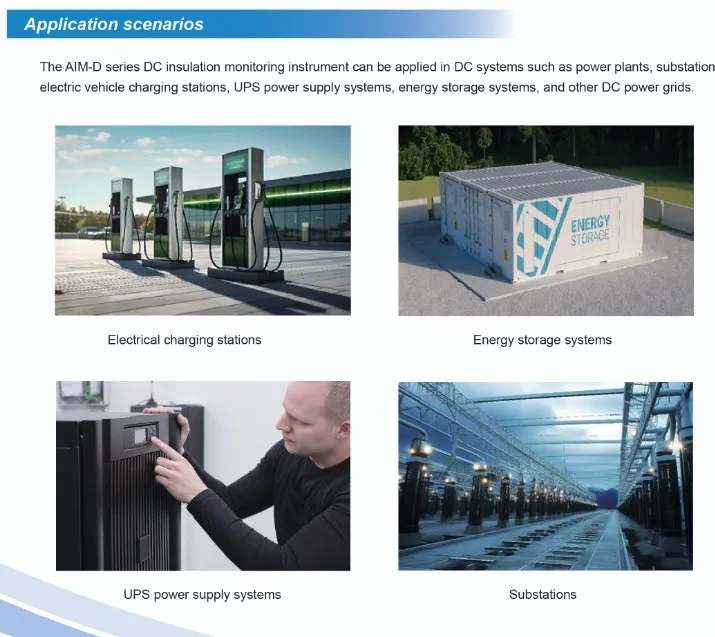
- Large-scale grid-side BESS
- Commercial and industrial energy storage systems
- PV + energy storage systems
- Wind + energy storage systems
- Energy storage battery cabinets
- Battery clusters and battery racks
- High-voltage DC distribution systems
- DC side of PCS systems
For European energy storage projects based on a 1500 V DC architecture, insulation monitoring can serve as an important part of the DC-side electrical safety monitoring system.
四、Dual-Level Alarms for Early Detection of Insulation Faults
BESS installations are typically designed for long-term operation. Battery systems, cables, connectors, and other DC components may be affected by temperature fluctuations, humidity, dust, mechanical stress, and long-term ageing.
These factors can gradually reduce insulation performance.
The AIM-D100-TS supports pre-alarm and alarm threshold settings.
For example, when insulation resistance gradually decreases from its normal level, a pre-alarm can be triggered to notify maintenance personnel that the system should be inspected.
If the insulation resistance continues to decrease and reaches the alarm threshold, the device can transmit an alarm signal to the upper-level control system through its relay outputs and communication interface.
This multi-level alarm strategy helps operators establish a more proactive maintenance approach:
Normal Insulation → Insulation Deterioration → Pre-Alarm → Inspection & Maintenance → Serious Insulation Fault
Compared with responding only after a fault has occurred, early detection of insulation deterioration gives maintenance teams more time to investigate and take corrective action.
五、RS485 Modbus-RTU for Easy Integration with BESS Monitoring Systems
A modern BESS is not an independent device. It consists of multiple interconnected subsystems, including:
Battery System → BMS → PCS → EMS → SCADA
Therefore, insulation monitoring data also needs to be accessible to the BESS control and monitoring system.
The AIM-D100-TS provides an RS485 communication interface and Modbus-RTU protocol, enabling communication with BMS, PLC, EMS, and SCADA systems.
With this architecture, insulation status can become part of the overall digital monitoring platform of the BESS rather than remaining an isolated local measurement.
Maintenance personnel can centrally monitor insulation resistance, alarm status, and related electrical parameters through the monitoring platform, improving the visibility and maintainability of the energy storage system.
六、Typical Application of AIM-D100-TS in BESS
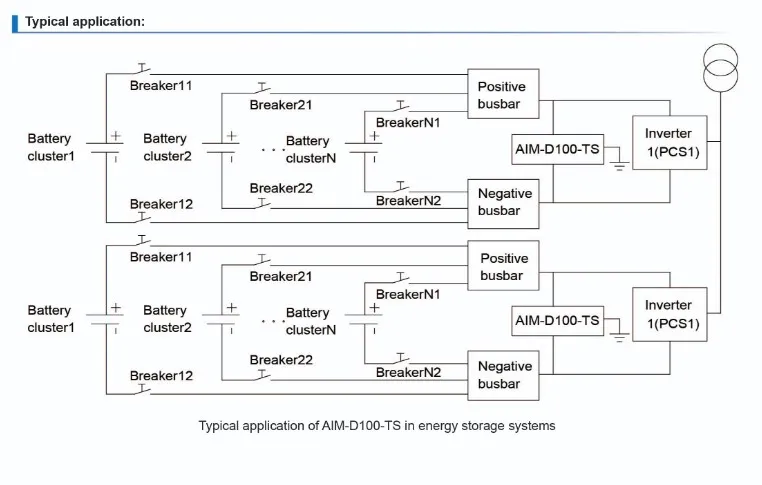
In a typical high-voltage energy storage system, the AIM-D100-TS can be installed inside the battery cabinet or DC distribution section to monitor the insulation status of the DC system.
For example:
Battery Rack 1
│
Battery Rack 2
│
Battery Rack 3
│
↓
┌───────────────┐
│ DC Bus │
│ + - │
└───────┬───────┘
│
┌───────▼───────┐
│ AIM-D100-TS │
│ Insulation │
│ Monitoring │
└───────┬───────┘
│
RS485 / Modbus
│
┌───────▼───────┐
│ BMS / PLC / │
│ EMS / SCADA │
└───────────────┘
When the insulation resistance between the positive or negative pole and earth changes, the AIM-D100-TS can detect the condition and generate a pre-alarm or alarm according to the configured thresholds.
Maintenance personnel can then inspect potential sources such as:
- Insulation inside the battery cabinet
- DC cables
- Connectors
- Busbars and distribution components
- Battery modules
- DC side of the PCS
- Areas affected by moisture or contamination
This can help narrow down the potential fault location and improve maintenance efficiency.
七、 Key Advantages of Acrel AIM-D100-TS
For European BESS system integrators, EPC contractors, battery cabinet manufacturers, and energy storage equipment manufacturers, the main advantages of the AIM-D100-TS can be summarized as follows:
(1)High-Voltage Energy Storage Compatibility
Supports 150–1500 V DC, making it suitable for high-voltage BESS and 1500 V energy storage architectures.
(2)Continuous Insulation Monitoring
Continuously monitors the insulation resistance between DC+ and DC− and earth, providing real-time visibility into the insulation condition of the energy storage system.
(3)Early Warning Capability
Configurable pre-alarm and alarm thresholds help maintenance personnel identify deteriorating insulation performance at an early stage.
(4) Fast Response
Provides selectable 500 ms or 1000 ms monitoring cycles to meet different BESS monitoring requirements.
(5)Digital System Integration
RS485 and Modbus-RTU communication enable integration with BMS, PLC, EMS, SCADA, and other monitoring systems.
(6)Flexible Alarm Outputs
Two relay outputs can be used for connection to external alarm or control circuits.
(7)Easy Cabinet Integration
DIN-rail or wall mounting makes the device convenient to integrate into battery cabinets, DC distribution panels, and control cabinets.
八、From “Fault Protection” to “Proactive Safety Monitoring”
For the future European BESS market, energy storage safety is moving from simple “fault protection” toward more proactive “condition monitoring.”
The BMS manages battery status, the PCS manages energy conversion, and the EMS manages energy flow and system operation. Meanwhile, the insulation monitoring device plays an important role in monitoring the insulation condition between the DC system and earth.
By integrating the AIM-D100-TS with BMS, EMS, and SCADA systems, operators can build a more comprehensive BESS safety monitoring architecture.
Battery Status + Electrical Parameters + Insulation Status + System Alarms + Remote Monitoring
Together, these functions contribute to a more comprehensive energy storage safety strategy.
Conclusion
As the European BESS market continues to expand, energy storage systems are rapidly evolving toward higher voltage, larger capacity, longer service life, and greater intelligence.
Against this background, DC-side insulation safety is becoming increasingly important.
For BESS architectures using 1500 V DC, continuously monitoring the insulation resistance between the positive and negative poles and earth can help identify potential insulation problems at an early stage and provide valuable status information to BMS, EMS, SCADA, and on-site maintenance teams.
With its 150–1500 V DC system voltage range, continuous insulation monitoring, dual-level alarm functions, RS485 Modbus-RTU communication, and flexible installation options, the Acrel AIM-D100-TS provides a compact and easy-to-integrate DC insulation monitoring solution for high-voltage BESS applications in Europe.
For European BESS system integrators, EPC contractors, battery cabinet manufacturers, and energy storage equipment suppliers, incorporating reliable insulation monitoring into the DC-side design can help further improve system safety, visibility, and operational efficiency.
The Latest

October 26, 2016
The Most Successful Engineering Contractor



Mar 23, 2026
DC Metering Solutions for EV Charging StationsContact US
Product Information
Quantity
Unit
Piece
Support order samples, customization, wholesale direct, and complete payment. If the product you look for does not have corresponding customized content, pls fill out the form below to contact us, and we will reply ASAP.